Blog
The road to the Coastal Zone Canada Conference
The last time I was in Prince Edward Island was in 2007. Next week, I’ll finally return to Charlottetown—this time, to attend the Coastal Zone Canada Conference. I’ll present in two conference sessions, so feel free to drop by if you’re around!
In session 5F — Flooding & Adaptive Structures on Tuesday, June 10, 2025 (13:00–14:30), I’ll talk about the Acadian diaspora connections to Nova Scotia dykeland and tidal wetland landscapes (co-authored with Kate Sherren). I’ve presented the first part of this work several times before (in Vancouver, Orford, and Halifax), but this is the first time I’ll discuss the design of a follow-up study that pushes it further. This project was funded by NSERC ResNet, who is generously supporting me to attend the conference.
In session 8A — Law, Governance, & Decision Making on Wednesday, June 11, 2025 (10:30–12:00), I’ll speak about Embedding climate change action in decision making by coastal municipalities (co-authored by Sandra Toze and Isabelle Caron). Since this is the first time I’m presenting this work, I’m a little bit nervous. But I’m really proud of this one, and I think that there’s a lot of value in the project. I’ll talk about what it means to study the use of evidence in coastal policy-making from the perspective of information science, and I’ll highlight what we can learn from the design of previous studies to make research questions more relevant. This project is funded through a Canada First Excellence Research Fund grant and a Social Sciences and Humanities Research Council of Canada scholarship.

Renewing a sense of place
I was born and raised in Ottawa. In early 2021, I moved from Orléans to Sandy Hill to be closer to my partner and uOttawa, where I completed my undergrad. Since I moved to the East Coast in 2023, I’ve returned home several times to visit friends and family. A few years back, Ottawa stopped feeling like home. Whether it was due to the COVID-19 pandemic or the so-called Freedom Convoy hardly matters. I always enjoy spending time with my loved ones when I return to the capital, but over the course of my previous visits, the city felt foreign to me—empty. But this time was different. This time I felt something.
Ottawa’s a strange place. On one hand, it’s beautiful. Its countless trails, parks, and coffee shops captivate both tourists and locals. Compared to other Canadian cities, its ability to foster work-life balance is ideal. And its location between Canada’s two largest cities is convenient to say the least. On the other hand, Ottawa’s a dark place. Its gothic revival architecture and bronze statues disguise themselves as vestiges of colonialism, erasing ongoing harms. The city’s wealth disparity continues to grow as luxury condos increasingly push vulnerable populations away from their homes and toward overcrowded shelters. Where the fertile lands of the St. Lawrence Lowlands once stood, multinational commercial retailers now capitalize from consumerism. Yet despite its flaws, Ottawa is, and always will be, one of my homes.
So what makes a place feel like home? How should we value (or disvalue) landscapes that inherit complex legacies—that simultaneously make us feel at peace and uneasy? These are some of the questions I intend to bring back to the East Coast with me.
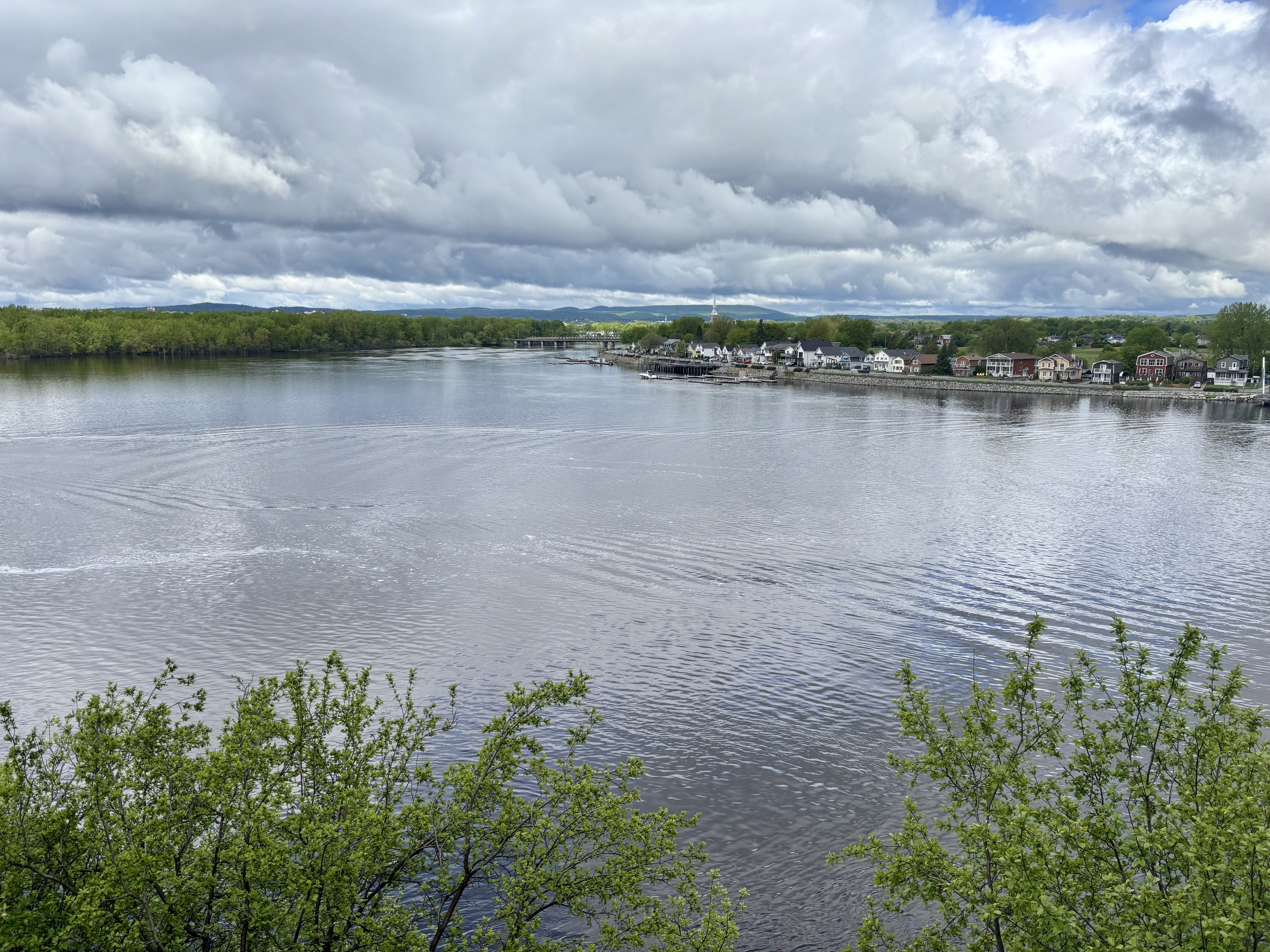
The confluence of the Ottawa and Gatineau rivers. The hills of the Canadian Shield appear in the background. I took this photo in May 2025.
It’s reading season!
Summer is knocking on the door, which means it’s time to read! I genuinely love reading, even if it tends to become a “side quest” and ends up making me manage my time poorly. It’s an academic guilty pleasure; what can I say?
The first book I finished in May is The Researcher’s Guide to Influencing Policy by Mark S. Reed, Professor of Rural Entrepreneurship and Co-Director of the Thriving Natural Capital Challenge Centre at Scotland’s Rural College. I’m currently working on a short review of the book for EIUI’s blog, so stay tuned for my impressions.
Next up on my reading list is Alexander Rosenberg’s Philosophy of Social Science (5th edition). I’ve been meaning to finish this book for a few months now and, although I’m only a few chapters in, it’s been such a pleasant read. Most importantly, I’m learning a lot about the factors that inevitably underpin methodologies.
I hope you are all finding time to read as well!
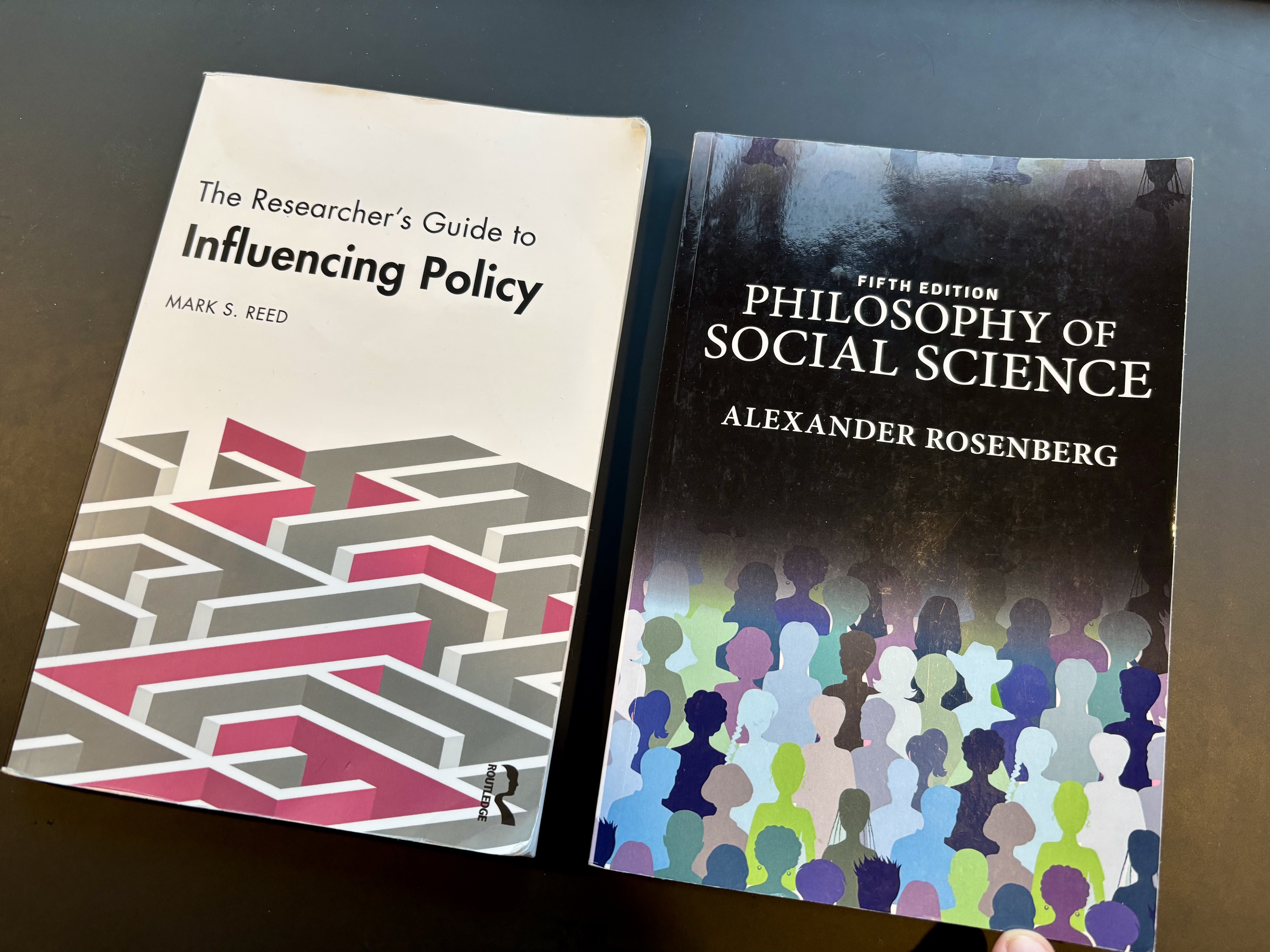
The books by Mark Reed and Alexander Rosenberg are my first summer reads of the year. I took this picture in May 2025.
 Alexandre Legault